Terrarium Store
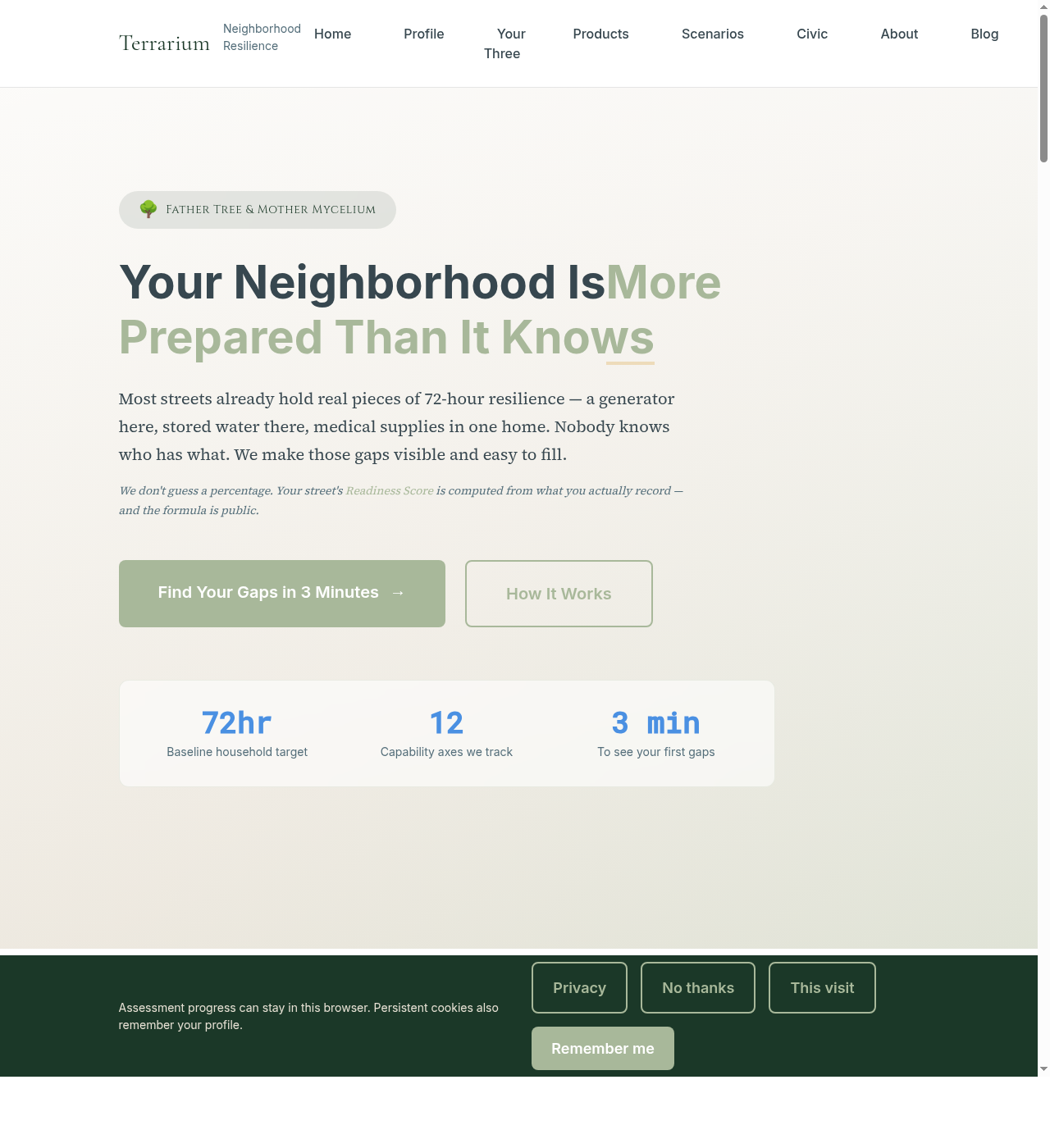
A live storefront where you start from a scenario, a seven-day power outage or a month without water, instead of a product shelf. It builds a capability profile across the twelve domains, scores products against your gaps, and links out to buy. It takes no payment.
DEPLOYED
What it is
Terrarium Store is the first piece of Terrarium with code behind it, and it is live. A visitor answers a short scenario assessment, the site builds a capability profile across twelve axes, and product recommendations are scored against the gaps that profile reveals. The twelve domains are the navigation, not a filter bolted on afterwards.
A social layer sits beside the commerce: name the three neighbours you would actually knock on, declare what you would share, and link lanterns with a real neighbour. Those declarations feed a per-household belief state held by the Umwelt engine, one small world per neighbourhood, so two visitors on the same street see a picture that includes each other without either seeing the other’s private data.
The readiness score is a published formula, not an estimate: one hundred times (0.40 capability + 0.35 connection + 0.25 sharing). Unknown is not fifty percent. Trust in a named neighbour fades to about a third after ninety days without re-confirmation; shared inventory counts in full and private inventory at sixty percent because, as the site puts it, only visible surplus turns a street into a system.
It recommends and links out; it does not take payment. An outbound click is logged as commissionable only when a tag and an account actually support it, and a price is never shown fresher than it is.
What a visitor can do
- Run one of 18 scenarios: a household baseline, a seven-day power outage, water disruption from seven to thirty days, food shortage from thirty to ninety days, a medical emergency, evacuation, shelter-in-place for two to twelve weeks, a climate-control failure, a communication-grid failure, and softer ones such as a family in distress, a weekly community dinner, a bunkhouse and a workshop house.
- Browse 208 product concepts and 614 offerings across all twelve domains, each offering typed as physical, information, knowledge or certification.
- Read 45 posts, every one audited in CI against the canon: the twelve domains by name, live catalogue slugs, fiction labelled as fiction, no agency endorsement implied.
- Keep a profile in the browser without signing in; assessment progress and the three named neighbours survive the cookie round-trip.
How it is built
- Node and Express with Pug templates. MongoDB in production, and a seed-file mode that runs fully offline for development and the CI audits.
- A Python sidecar runs the Umwelt social world: event-driven only, deterministic replay, and measured at 207.6 ms per event with 200 houses on 22 August 2026.
- A deploy gate that refuses to certify a container that cannot serve the store, and a container that comes up degraded rather than dying when the database is unreachable.
- CI runs three jobs on every push and pull request: the Node suite against a MongoDB service, the quantum-world tests with a cost probe, and a Docker build that boots the image.
What exists today
Live at storefront-production-afa0.up.railway.app: on 21 October 2026 it answered with the title “Terrarium: Neighborhood Resilience”, checked from this site’s repository and nothing more. The repository’s own evidence ledger keeps four tiers, and its live-measured tier is empty on purpose: no traffic, conversion or outcome number has been recorded.
737 tracked files and 129 commits, 93 of them in August 2026; last push 19 October 2026; three pull requests open on affiliate attribution and offer selection. The shipped catalogue measures 187 stale prices, 30 unknown and 0 fresh, and shows them as such.
Not done
No live measurement yet: visitors, conversions and outcomes are unrecorded.
The Amazon affiliate tag is unset and the account status unknown; Etsy is blocked by a social-presence requirement that has not been verified. Until one is restored no click earns anything, and the site says so.
Most catalogue prices are stale, and are shown as stale.
Next
Restore one valid Amazon offering end to end (tag, account evidence, fixture), then return to Etsy. Then measure one street’s use.
Built with
Node 20+ Express Pug MongoDB Python sidecar (Umwelt) Docker Railway
Inspect the work