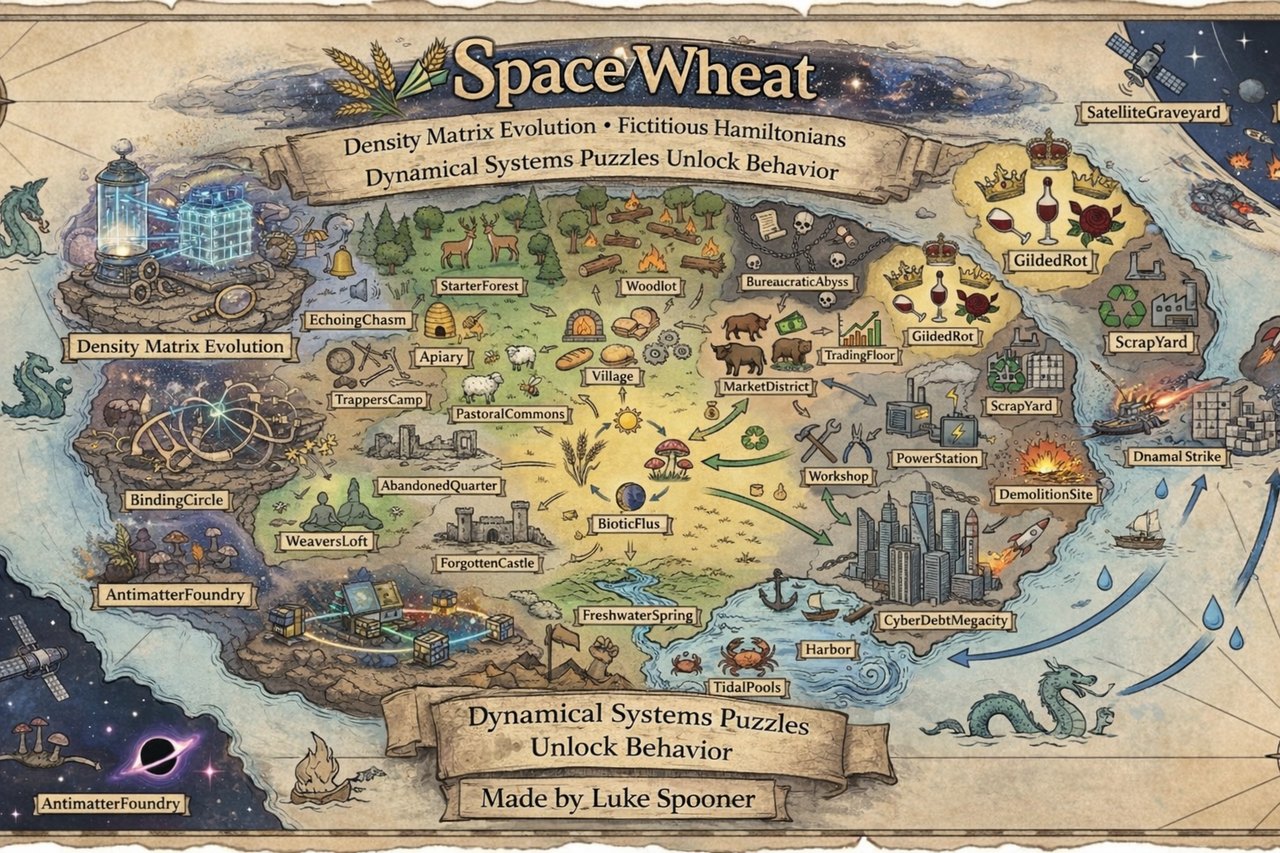
SpaceWheat
A farming game built on a real quantum simulator: every field is a density matrix, every season is unitary evolution, every harvest is a measurement. Public source under MIT, Godot 4.5, with a Windows alpha build from 19 October 2026.
SHIPPING
What it is
SpaceWheat is a farming and optimisation game in which the physics is the engine, not a theme. Each biome holds one density matrix that evolves under its own Hamiltonian, exactly, through the unitary propagator. Planting prepares a state, harvesting samples it by the Born rule, and the reward for a harvest is the surprisal of what was learned, so improbable outcomes pay more. The story layer is computed from the quantum state: faction moods from observables, narrative beats when live quantities cross a threshold.
The game teaches by refusing. Nothing can be copied, because the no-cloning theorem is structural. A plot that has decohered into a fog cannot be rescued by planting, because rotations preserve purity; only measurement or a dissipative kick brings purity back. In the open-world economy you can sell your coherence to the environment, and the reverse trade does not exist: the button is permanently disabled with the reason written on it.
The campaign begins in a closed system, the enclave, where nothing decays and the player’s measurements are the only irreversible acts. The post-story campaign, What Fades, walks out into open country: 64 of the 164 biomes author real Lindblad channels, pumps, decays and dephasing, so the world map is a thermodynamic map. The open-system path is off by default and wakes per biome.
A companion document grades every physics concept the game claims to teach as exact, faithful or suggestive, with the test file behind each grade: density matrices, gates, Born-rule collapse, weak measurement, purity and entropy, mutual information, geometric phase, spectrum conservation, the Zeno effect.
The core loop
- Strike a qubit: Born-sample it and it collapses to one emoji. Explore first to open the register and see the odds.
- Gather: cash the outcome for resources. The reward is the surprisal, −kT·log p, with a bonus if the icon is in your signature.
- Track and incorporate: let a qubit accumulate geometric phase until it ripens, then incorporate its icon. Your signature grows and story beats fire.
- Compose biomes by planting atoms, reap to fast-forward evolution, trade on the market. Win the campaign by composing a village whose spectral gap stays small: a plural island that physically cannot collapse into one shape.
What exists today
Public source under MIT, Godot 4.5 with a native C++ extension for the physics. The README counts 164 quantum physics tests across six suites, 142 of them gate tests, and the build badge is wired. Two releases exist: v0.2.0 for Linux (17 June 2026) and v0.1.7-alpha for Windows (19 October 2026, marked pre-release).
Not done
No independent play receipt yet: nobody outside the project has recorded a session from either release.
The Windows build is an alpha. Profiling and packaging are what remain before a release that is not marked pre-release.
Next
Ship the playable release, then a demo video and an explanation thread. No new systems before it ships.
Built with
Godot 4.5 GDScript C++ (GDExtension) density-matrix simulator
Inspect the work
for physicists: every claim graded