ROI Manifold
An economy calculator for the strategy game Beyond All Reason: for every structure you could build next, how long until it pays for itself, drawn as a surface you can slice in 2D or turn in 3D. Public source under MIT.
DEPLOYED
What it is
In Beyond All Reason every generator, extractor, constructor and factory costs metal, energy and build time, then earns them back. The usual rule of thumb, how long until it pays for itself, collapses once income is high: a naive return number shrinks to the build time and every option looks equally good. ROI Manifold keeps the full investment in the payback, so the comparison survives a growing economy.
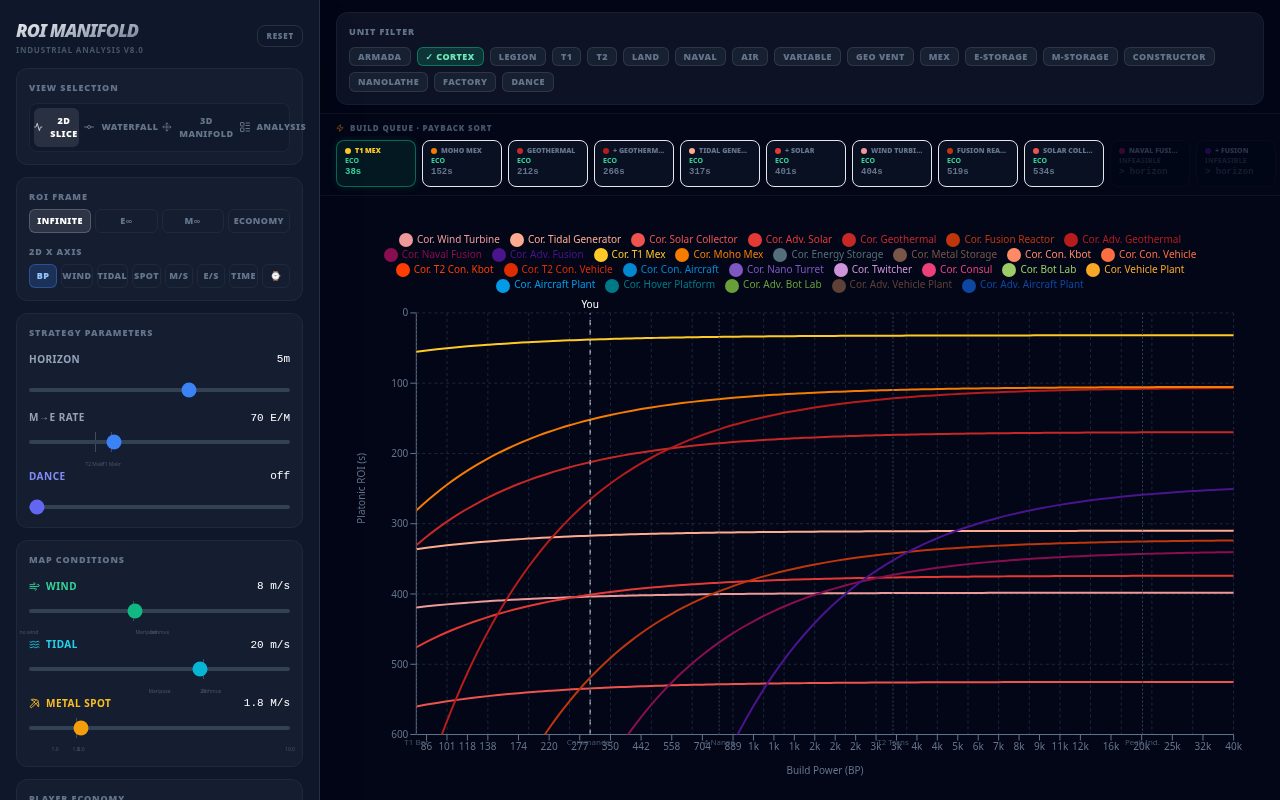
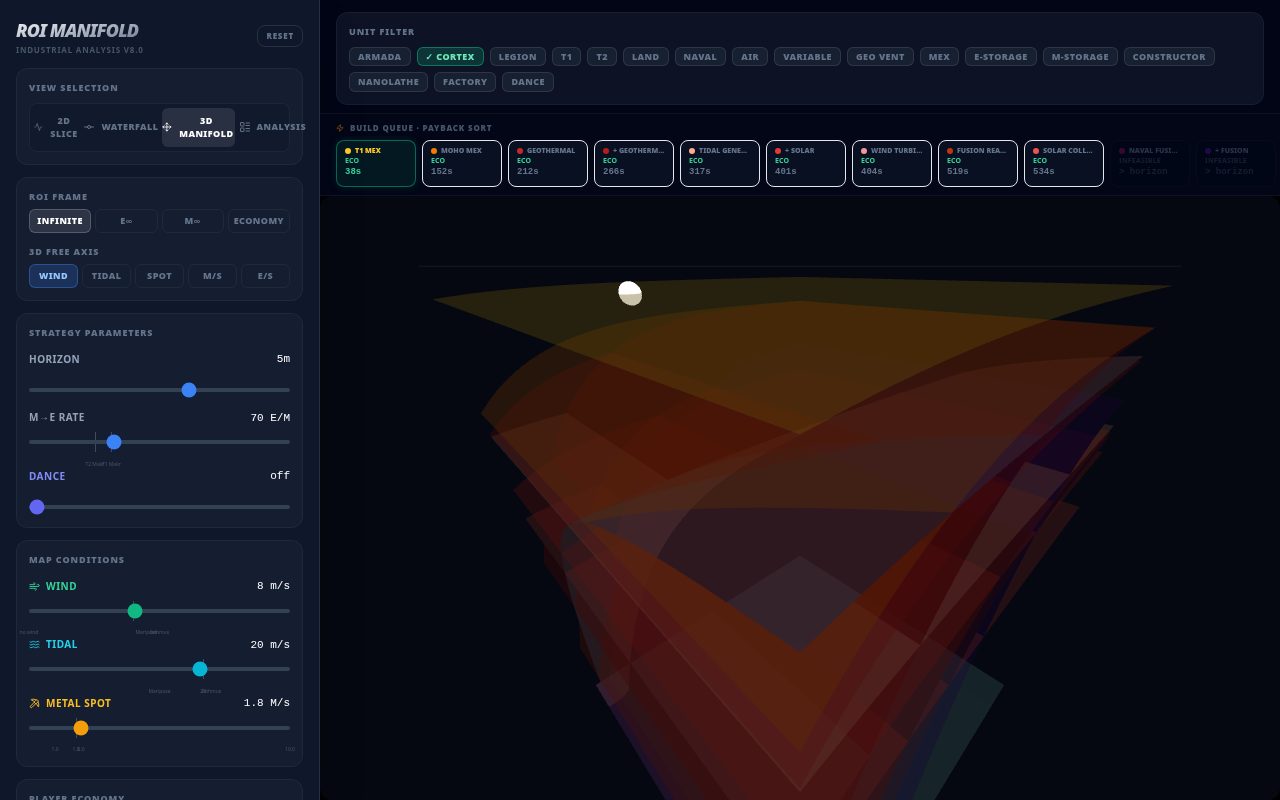
Payback depends on your build power, metal and energy income, a metal-to-energy exchange rate, a planning horizon, and the map: wind, tidal strength and metal-spot value. The page draws the whole surface rather than one answer, as a 2D slice along any axis or a 3D manifold, beside a build queue sorted by payback. It sits beside Verdance’s Ashes, the campaign layer for the same game.
What it shows that the rule of thumb hides: at the page’s opening settings (Cortex, 8 m/s wind, tidal 20, five-minute horizon), a Tidal Generator pays back in 317 s against 404 s for a Wind Turbine, and a Fusion Reactor in 519 s beats a plain Solar Collector at 534 s. The cheap, obvious build is not the efficient one.
What exists today
Public source on GitHub under the MIT licence (React and Vite, Recharts for the slices, Three.js for the 3D view). The live page answered on Railway on 3 November 2026; the payback figures above are read off its build queue in the screenshot below, taken that day.
Not done
The unit numbers are a snapshot of the game’s values and are not checked against the current release.
Built with
JavaScript React Vite Three.js Recharts
Inspect the work